


Digital Identification: How to Tell a Real Customer from a Fraudster
How to Tell a Real Customer from a Fraudster
Remote services have transformed the basic logic of customer interaction. Banks issue loans without a visit to the office, microfinance organizations approve loans in minutes, logistics companies onboard drivers through online forms. Speed has become a competitive advantage, but with it have come new vulnerabilities.
Fraudsters have long realized that the remote format gives them a head start. Other people’s passports, forged documents, synthetic identities, masks – the toolkit is constantly expanding. The question “who are we dealing with” has turned from a formality into a critically important operational task.
Cross-referencing application data
The simplest method is comparing what a person reports about themselves with what is available in official registries. Full name, date of birth, passport details, taxpayer ID, phone number are checked against databases of the Federal Tax Service, Rosreestr, Unified State Register of Legal Entities, and other open sources.
This method is fast and handles obvious inconsistencies well. But it has a fundamental limitation: it verifies data, not the person. A fraudster who has gained access to someone else’s passport or purchased a ready-made package of personal data will easily pass the application check. Therefore, registry cross-referencing has become a mandatory but insufficient element of analysis.
Document verification and photo comparison
The next step is visual document inspection. Users upload a photo of their passport; the system analyzes the image and compares the portrait in the document with a selfie the person takes at the time of application.
Modern neural network models handle the task even with low-quality images. Additionally, systems analyze the document itself for signs of editing: erasures, photo replacement, data manipulation. Font characteristics, lighting uniformity, integrity of security elements – all of this can be automatically analyzed.
Cross-referencing multiple photos of the same person from different sources improves result accuracy. If the face from the passport matches, for example, a photo from a resume – the confidence level increases significantly.
Liveness detection
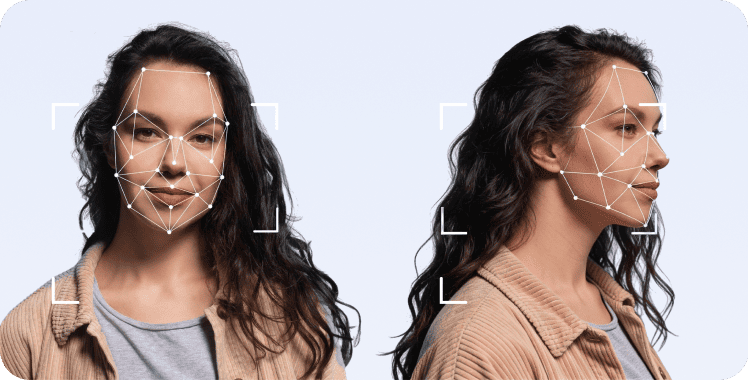
This technology determines that a live person is in front of the camera, not an image of them. The system analyzes the video stream and distinguishes a real face from a photograph, printout, video recording, or silicone mask.
Passive verification analyzes natural micro-movements, skin texture, light reflection patterns – features that cannot be reproduced on a flat image. Active verification asks the user to perform an action: blink, turn their head, smile. An additional factor is age estimation from the photo. If a person presents a passport of a forty-year-old, but the algorithm detects a clearly different age – this discrepancy becomes a signal for additional verification.
Behavioral analysis and activity monitoring
Verification does not end at registration. The timing and nature of online activity, types of devices used, connection geographies, social platform contacts – all of this forms a behavioral pattern that is difficult to fake.
Network activity analysis reveals anomalies: a person registered from one city, and an hour later logged in from another. A social media profile was created two weeks ago, has no publication history, and has three contacts. None of these signals alone proves fraud, but together they form a substantial risk picture.
BIT: tools for comprehensive verification
BIT company develops information and analytical systems for the financial sector and logistics, covering the entire range of remote identification methods described.
IAS "Stop-Fraud" – a fraud prevention platform based on neural network technologies and cross-referencing of data. Three sequential verification stages: data entry, image comparison, and source search. Algorithms recognize faces and text even in low-quality photos, detect signs of document tampering, and perform real-time video analysis to distinguish a live person from an impersonation attempt. All instances of fraudulent activity are consolidated into a single profile of the individual. The system integrates with corporate platforms via API and operates under high-load conditions. It is used in financial and credit institutions, logistics companies, and industrial enterprises.
IAS "NEO" – an analytical platform for in-depth verification of individuals and legal entities using open sources. Covers social platforms, bulletin boards, resume databases, official registries, and proprietary data archives. AI-powered algorithms process both structured and unstructured data – texts and images – identify non-obvious connections between entities, and provide round-the-clock change monitoring. The system is used by the top 10 Russian banks, with a daily query volume exceeding one million. The platform runs on Windows, macOS, and Linux.
Both solutions fully comply with the legislation of the Russian Federation in the field of information security. Contact the BIT team – specialists will demonstrate how the systems work on real-world cases and help configure a solution tailored to your organization’s needs.